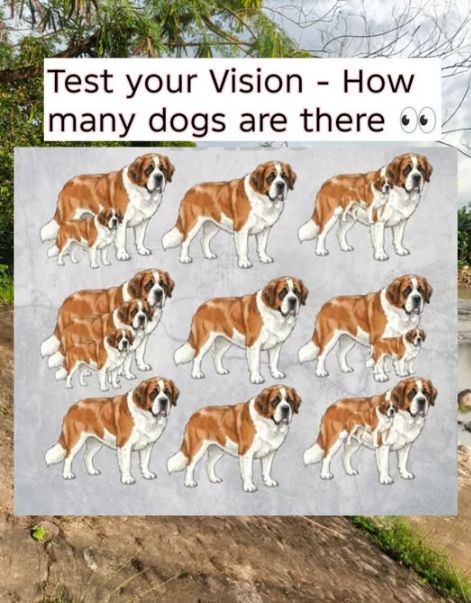
 Test your Vision- How Many dogs are there?
At first glance, the image looks deceptively simple—almost too ordinary to hide anything unusual. A peaceful outdoor setting stretches across the frame, perhaps a park, a backyard, or even a countryside clearing. The colors are soft and inviting: greens from the grass, browns from tree trunks, and maybe a splash of blue from the sky peeking through the leaves. It feels calm, harmless… and yet, there’s a challenge hidden within it.
“Only the keen-eyed can spot them! Count the dogs!”
That’s the task. Simple, right?
But within seconds of staring, you realize something strange. The longer you look, the less certain you become.
At first, you might confidently say, “I see three dogs.” They’re obvious—maybe one sitting near a tree, another lying in the grass, and a third partially visible behind a fence or bush. Easy enough. But then, your eyes start adjusting. You notice shapes that didn’t register before.
Wait… is that another dog?
There, near the shadows—what looked like a rock suddenly has the outline of ears. A patch of darker grass begins to resemble a curled-up body. The branches above seem to form a face when viewed from the right angle. Suddenly, your initial count feels rushed, even careless.
You start over.
Now you scan slowly, methodically. Left to right. Top to bottom. This time, you’re not just looking—you’re searching. Your brain begins to shift from passive observation to active pattern recognition. Every shadow becomes suspicious. Every cluster of leaves might be hiding something. You lean closer, squinting, trying to separate illusion from reality.
And that’s when the puzzle reveals its true nature.
This isn’t just about counting dogs. It’s about perception.
Some of the dogs are obvious—clearly drawn or positioned in plain sight. But others are cleverly camouflaged. Their shapes blend into the environment: a dog’s back becomes indistinguishable from a mound of dirt; a pair of ears hides within the jagged outline of leaves; a tail curves in a way that mirrors a fallen branch. The artist—or creator—has carefully embedded these forms so that your brain doesn’t immediately recognize them as animals.
Why?
Because our brains are wired to simplify what we see.
When you first glance at an image, your mind prioritizes efficiency. It identifies the most prominent shapes and labels them quickly: “tree,” “grass,” “dog.” Once it feels it has enough information, it stops digging deeper. That’s why the hidden dogs remain invisible at first—they don’t fit the immediate pattern your brain expects.
But once you know there are more dogs, everything changes.
Now your brain is on alert. It begins to question its assumptions. That “rock” might not be a rock. That “shadow” might not be just a shadow. You start seeing possibilities instead of conclusions.
And that’s when the magic happens.
One by one, the hidden dogs reveal themselves. A shape clicks into place. A vague outline suddenly becomes unmistakable. It’s a satisfying moment—like solving a riddle or cracking a code. Each discovery feels like a small victory.
But here’s the twist: even after finding several dogs, you might still be wrong.
Because there’s always one more.
These kinds of visual puzzles are designed to push your perception to its limits. They play with figure-ground relationships—the way we distinguish objects from their background. They exploit camouflage, symmetry, and suggestion. Sometimes, they even rely on your imagination to “complete” shapes that aren’t fully drawn.
And they teach an important lesson: seeing isn’t always believing.
Two people can look at the same image and come up with completely different answers. One might confidently say there are five dogs, while another insists there are eight. Who’s right? Maybe both are partially correct. Maybe neither has found them all.
That’s what makes the challenge so compelling.
It’s not just about getting the “correct” number—it’s about the process of looking closer, thinking differently, and questioning what you assume to be true.
In a way, this puzzle mirrors how we experience the world.
How often do we overlook details because we think we’ve already understood the bigger picture? How many “hidden dogs” exist in our daily lives—things we fail to notice because we’re not looking carefully enough?
This simple challenge becomes a metaphor for awareness.
The keen-eyed aren’t necessarily those with better vision. They’re the ones who take their time. The ones who stay curious. The ones who are willing to look again, even when they think they’ve already seen everything.
So, how many dogs are there?
You might be tempted to jump to an answer. Maybe you’ve already counted them in your mind. But before you decide, take another look—slowly this time. Let your eyes wander. Question every shape. Rotate your perspective if needed. Sometimes, tilting your head or stepping back can reveal what was hidden before.
And when you finally think you’ve found them all… pause.
Ask yourself: “Am I sure?”
Because in puzzles like this, certainty is often the biggest illusion of all.
The real joy isn’t in the final number—it’s in the discovery. The moment when something invisible becomes visible. When chaos turns into clarity. When your brain suddenly says, “Ah, there it is!”